Sunday, April 27, 2014

The Godfather: Screening Report

1)            Relate what was discussed in class or the text to the screening.

Throughout its history, film has been an ever-changing industry.  Every couple years there is a new that changes it all.  From Disney and animation to Welles and Citizen Kane, the film industry has undergone many changes.  In the sixties we saw a younger generation stand up and make movies that spoke for them, movies that dealt with freedom of the young, like the Graduate.  Now the turn of the decade brought a new change in the film industry.
A new sense of freedom was welcomed in the art of filmmaking.  Directors were free to create movies they felt were socially responsible.  Topics for the “real people”, more realistic movies were being made at the turn of the century.  That includes more graphic violent scenes are more frequent and graphic sexual scenery.  This created more mature movies and a new way of rating movies.
New forms of ratings include PG, PG-13, PG-17, and Rated R.  These ratings took into a count content material, language, violence and sexual content.  The Godfather was released in 1972, during the beginning of the changes.  At time for it’s release it was rated R, for its violence, crime, language and sexual content.  This movie was one of the first films to include an “anti-hero”. Even though the Corleones plotted and executed murder on others, and partakes in other criminal activity you could not help but root for them and root for their safety.  You begin to dislike the other “families” for all their low blows and intrusions and begin to liken the Corleones for their loyalty and family orientation.  The movie traps you in and won’t let go until 175 minutes later, no wonder it is one of the best, winning 3 Academy Awards.
2)            Find a related article (on the film, director, studio, actor/actress, artistic content, etc.) and summarize the content.  You may use the library or the Internet.

This movie is a movie you cannot refuse! The Godfather, although fictional, was based on the real life mafia of New York.  It makes a lot of sense for people to draw comparisons between the movie and a real life cooperation.  According to Justin Moore, the CEO and founder of Axcient, there is a lot in common between CEO’s and the fictitious characters in The Godfather.  Moore had noticed that “there are some universal themes in the movie [The Godfather] I can relate to as a CEO” (Dishman, Fastcompany, 2012).  In his opinion, the characteristics the mob leaders in the film and the CEOs of America have in common is their ability to build a strong community, hold people accountable, don’t get emotional, and always having time to spend with your family (Dishman, Fastcompany, 2012).   According to Moore, a leader has to have these qualities something that mob leaders and CEOs have in common.  In the movie Don Corleone saw everything as a business even though they called it a family.  His business was important to him and he did not hold his tongue when he feels his business in compromised.
Since its release “The Godfather” has been praised for is movie editing effects to the way it tells the story.  The way the story it is told, it feels real. It is a film that drags you in, and you are invested in the business, and you want them to succeed. In his review of the movie, Roger Ebert, he notices how even though the movie is a bit long, one if engulfed in the story.  You can’t help but just stay and watch the rest of the movie.  It has the suspense of a thriller, the romance of a love story and the gruesome of a horror movie all in one.  Ebert points out “it absorbs us so effectively it never has to hurry” (Ebert, 1972).  He compliments the graphic and detailed visuals of the movie, and commend for staying true to the book it is based of.  Including all the car bombs, murders, shots and back stabbings.  It is a movie that although hardcore, kind of stays true to life.  The Mob is a business, a deadly one, but a business nonetheless.   You have to make decisions that one feels is good for business, or money.  And the movie depicts that.

3)             Apply the article to the film screened in class.   How did the article support or change the way you thought about the film, director, content, etc.?
Both of these articles supported the “anti-hero” idea that followed the movie.  These guys are not the greatest guys in the worlds, they cheat, hurt, plot and kill.  Some of the scenes that were shown in the movie were really gruesome, it has all the qualities to make you hate these men who kill for the sake of money. But in the movie you rooted for them.  With comparisons to real life CEOs, you really see the mob leaders in a new light.  They might not be your conventional businessmen, but they are.
Money does make the world go around for these “businessmen”, in the film you see Don Corleone reject working with a drug salesman because of the negative attention that might bring to his “business”, and the replications that followed that decision like being shot and almost getting killed. 
The emotion and loyalty behind every family member really makes you even root for them even more.  The care of Michael, his youngest son, and how devoted he was to his father’s well being, saving him that one night in the hospital.  Also Sonny, even though hot tempered, he did it all because he wanted to avenge his father’s shooting.  It was all in the name of family, something we can all relate to.  To Michael and Sonny Corleone, family was number one, and to most of us, family is on top and we can all relate to the characters in the movie. 
This movie is also one of the “quotable” movies.  Some of the most famous movie quotes come from this film including “I'm gonna make him an offer he can't refuse.” And “Revenge is a dish best served cold,” “ I have a sentimental weakness for my children and I spoil them, as you can see. They talk when they should listen”, and “that's a Sicilian message. It means Luca Brasi sleeps with the fishes.” And so much more, it is always fun to see the original context of some quotes that you have everywhere else except its origin.

4)            Write a critical analysis of the film, including your personal opinion, formed as a result of the screening, class discussions, text material and the article. 
As we have seen the film industry has undergone major changes in history.  Starting out with black and white silent movies, then adding sound, then color, then animation, the film industry has been an ever-changing one.  The Godfather continues this trend of movies that are different than the ones in the past.  By time the seventies rolled around more people we open minded (see the 1960s), they were willing to try and see it all.  Movies were beginning to be less restricted and filmmakers wanted to make movies that mirrored real lives, including sex and violence.
The Godfather is a long movie, but it does not feel long at all.  You become invested in each character, you go through every emotion they do.   Marlon Brado’s portrayal of the Don I think was perfect, a man who has earned the respect from everyone.  The way he talked, slow and concise, to the way he walked, slow and upright, the viewer can tell he is a man of power.  To the cockiness of Michael because of his father, it is all believable because it happens in real life.  The Godfather is a dark movie and the lighting helps the mood of the film.  It is mostly entirely in dark lighting and it gives you the mood that you feel like something is going to happen, soon.  The Godfather has all the makings of a classic, it is a movie too good to refuse!


CHECKLIST FOR PLAGIARISM 

1) ( x ) I have not handed in this assignment for any other class. 

2) ( x ) If I reused any information from other papers I have written for other classes, I clearly explain that in the paper. 

3) ( x ) If I used any passages word for word, I put quotations around those words, or used indentation and citation within the text. 

4) (  x) I have not padded the bibliography. I have used all sources cited in the bibliography in the text of the paper. 

5) ( x ) I have cited in the bibliography only the pages I personally read. 

6) (x  ) I have used direct quotations only in cases where it could not be stated in another way. I cited the source within the paper and in the bibliography. 

7) ( x ) I did not so over-use direct quotations that the paper lacks interpretation or originality. 

8) ( x ) I checked yes on steps 1-7 and therefore have been fully transparent about the research and ideas used in my paper. 


Name: ______________Juan Ortiz___________________  Date: ______4/27/14____________

Reference:
Dishman, Lydia. "An Offer You Can't Refuse: Leadership Lessons From "The Godfather"." Fast Company. N.p., n.d. Web. 26 Apr. 2014.            <http://www.fastcompany.com/1826672/offer-you-cant-refuse-leadership- lessons-godfather>.

Ebert, Roger. "The Godfather Movie Review & Film Summary (1972) | Roger Ebert." All Content. N.p., n.d. Web. 26 Apr. 2014.            <http://www.rogerebert.com/reviews/the-godfather-1972>.

Saturday, April 12, 2014

The Graduate- Screening Report


11)     Relate what was discussed in class or the text to the screening.

The sixties are an interesting era, everything in society, as they knew it, was flipped 180 degrees. Values were revaluated, protests were constructed and the younger generations were making their voice heard. The sixties were a time of change and the culture surrounding the movement was the first to be affected. 
In the film industry that change could be more apparent.  Prior to the sixties movies rarely had sex play an important role in the movie or have it as a recurring theme.  Movies like It Happened One Night and Vertigo rarely had sex plot line they might have had innuendos as jokes but did not actually let sex play an important role in the movie.  But after the sixties filmmakers were no longer scared to have characters have sex appeal, actually from then until now they prefer characters with strong sex appeal.  The Graduate directed by Mike Nichols was a movie about a young recent college graduate, Benjamin who ends up having a sexual affair with an older married woman, Mrs. Robinson.  Mrs. Robinson just happens to be married to Benjamin’s father’s friend.  Benjamin then falls for the Robinsons daughter, Elaine.  A twisted plot, yes.
The Graduate released in 1967 represented or summarized what the sixties were all about and reflected young adults of that time.  Upon its release The Graduate received critical praise for its humor and drama.  It also managed to earn over $100 million in the box office in the 40 plus years since its original release.

2.  Find a related article (on the film, director, studio, actor/actress, artistic content, etc.) and summarize the content.  You may use the library or the internet.
 Since its release critics have been divided on whether Benjamin in The Graduate accurately portrays the youth of the sixties or if it stands alone in an era that was all about change.  According to Mehara Bonner of Popmatters Benjamin played by Dustin Hoffman can be relevant today as much as it was in 1967. IN a primary example of timeless themse in the movie Bonner states:
“ The story of the film easily appeals today’s audience because A) we have all at one point questioned the direction that our lives are leading.”
                                                                                    (Bonner, 2007)
And it’s true, every college student after they graduate ponders the decision of what to do next with their lives.  After four years of having a safety net, college, now one has to face life and actually be an adult.  In the one montage you can see that all Ben does is lounge by and in the pool and go to the hotel to meet and greet and have sex with Mrs. Robinson and that I about it.  In this generation most kids just lounge around and go partying, delaying moving on with their life.
            Many critics like Bonner also noted the difference between Benjamin and other male lead characters in other movies from the same period.  The sixties were all about protest and anti-war propaganda, but no war was ever mention in the movie and there was also the hippy movement of the sixties, another of which was not mentioned in the movie.  “Ben is neither a soldier in the war, nor is he outspokenly against the war, and he certainly doesn’t fit the peace-loving hippie type.” (Bonner 2007)  Benjamin was a universal young man.  This movie could have easily taken place in any decade from the sixties until now.  But even though it is a movie that can be placed at any decade for any generation it has a movie that can best represent the social reform of the sixties.  Especially during the final scene where even though the wedding is over he still steals the bride and runs away with Elaine. That scene shows their dismay of social norms.

“The complete rejection of social norms that occurs at the end of the film sent a message to the youth of the 1960s that is still relevant today: it is time for a new generation to come into their own.”
                                                                                          (Boner, 2007)

3) Apply the article to the film screened in class.   How did the article support or change the way you thought about the film, director, content, etc.?
            The movie and the article both kind of supported my opinion of the film.  From the beginning I thought the film was just funny, it had very good humorous and awkward moment that worked well.  But watching the movie I could totally agree with the thought that Ben does represent youth from the sixties but also can represent youth from generations then and now.
            The Graduate has so much of today as much as it has of the sixties.  It is a rebellion story, Ben went against all the adults in his life and did what he felt was right for him.  The film was all about rebellion, rebellion from the youth and society but also rebellion within the film industry.  The Graduate is a movie that is kind of solely based on a sexual relationship.  Sex was a major theme and premise for Ben’s plotline. But also was the idea of being lost after graduating college.
            Many young adults don’t know what to do with their lives after graduating either college or high school.  Should they continue with their education, or jump into the workforce or do something else like get married start a family, its a lot of thinking that goes into a decision that affects your entire life.

4) Write a critical analysis of the film, including your personal opinion, formed as a result of the screening, class discussions, text material and the article. 
            The Graduate is a movie that does what it intends to do, entertain you.  It is a funny movie.  It is one of those real movies that have awkward moments that are so funny, that it works.  But it also shows the uncertainty and the downfall of not being decisive in your life and letting others tell you what to do.
            The sole reason why Ben began his affair with Mrs. Robinson was because she told him to.  He was forced to tell Elaine because Mrs. Robinson said she would.  It wasn’t until after he met and started chasing Elaine that he began making his own decisions.
            The movie made its mark in our culture because it does depict the though process of a young adult.  But the music also had a cultural impact; Mrs. Robinson the lead single from the soundtrack by Simon and Garfunkel peaked at number one on the Billboard Hot 100 charts.  The music fit so well with the actions going on in the movie, it sets the mood for what is going on.  It is also a different way of doing a movie, sometimes one scene will start while another scene is still on the screen but it gives it a sense of melodrama or realness to it.
            The Graduate is a funny dramatic movie; it goes through every emotion by almost all the characters.  You get to see how quick characters and people can quickly change by a sudden change in feeling or a sudden event makes one grow up.  Benjamin goes from being told what to do and being uptight to being literally a free for all and learning that he has to make his own decisions and not rely on others.  It is a lesson that we all have to learn at one point or another.


CHECKLIST FOR PLAGIARISM 

1) ( x ) I have not handed in this assignment for any other class. 

2) ( x ) If I reused any information from other papers I have written for other classes, I clearly explain that in the paper. 

3) ( x ) If I used any passages word for word, I put quotations around those words, or used indentation and citation within the text. 

4) (  x) I have not padded the bibliography. I have used all sources cited in the bibliography in the text of the paper. 

5) ( x ) I have cited in the bibliography only the pages I personally read. 

6) (x  ) I have used direct quotations only in cases where it could not be stated in another way. I cited the source within the paper and in the bibliography. 

7) ( x ) I did not so over-use direct quotations that the paper lacks interpretation or originality. 

8) ( x ) I checked yes on steps 1-7 and therefore have been fully transparent about the research and ideas used in my paper. 


Name: ______________Juan Ortiz___________________  Date: ______4/12/14____________

Reference:
Bonner, Mehera. "The Graduate." PopMatters. N.p., n.d. Web. 12 Apr. 2014. <http://www.popmatters.com/review/the-graduate/>.


Sunday, April 6, 2014

Vertigo: Screening Report


    1)    Relate what was discussed in class or the text to the screening.


            Have you ever watched a movie or TV show and you felt like it was making you crazy? A movie that you thought you knew what was going on and then it surprises you with a left-field move?  Well if you have, then you have probably watched Alfred Hitchcock’s 1958 “masterpiece” Vertigo.  Vertigo is a film that throughout makes you feel like the disease that it is talking about with all the circles it makes trying to explain or as it develops the plot.
During its release the film industry was starting to go through major changes. The studio system of film was on its way out and a new system of producing and releasing films would be established.  Before the 1950s films were more often produced, released and distributed by one of the major studios (Paramount, MGM, Warner Bros., RKO, Fox Films etc..).  Each of these studios would also own a chain of movie theatres that would show these films.  Often theatres would want to show and Paramount picture, for example, and Paramount would agree to allow the theatre to show the A-list film but would also force them to show their B-list or less stellar pictures. This would create a monopoly in the film industry.
In 1948 the government was inserting itself and creating guideline for the film industry and decided to sue Paramount picture in a step that they hope would destroy the monopoly that film studios have created.  By 1954 the studios had lost. Studios were forced to sell their many theatres and had to actually sell their movies in order to get them played.  But the problems for the film industry did not end there.
With the end of the studio system, competition was created which is now the root of the business world. A competition that the film industry did not expect, television.  In the 50s television was gaining popularity.  Audiences would now prefer to stay at home and watch TV rather than go out to a movie theatre and watch one movie.  Film studios were aware so they had to come up with something to rival the television.  Early televisions were made mostly in black and white so the first tactic studios used to compete with TV was movies in color, like Vertigo. Vertigo was full of color and the scenery was made more beautiful shots.  Also the effects that Hitchcock used makes the film even more interesting and cool.  Other “gimmicks”, like cinemascope, were also used to make movies more interactive to attract more audiences, but TV was too much of a strong opponent that studios caved in and would later start making movies for TV.

2) Find a related article (on the film, director, studio, actor/actress, artistic content, etc.) and summarize the content.  You may use the library or the internet.
            In 2012 Vertigo did something that up until then seem unobtainable; it dethroned Citizen Kane in “Sight & Sound’s esteemed 10-yearly poll of critical favorites” (Robey, 2012).  Up to that Vertigo had been number two on the list. So the critics do love the movie, but now it is the best film of all time. “We have a new Best Film of All Time, and it could well be here to stay” (Robey, 2012). The film’s plot although confusing and strange, it is very interesting.
            Like most classic movies that today are applauded, when it was first released Vertigo did not get that much approval from the critics and was considered “a dismaying flop when it came out in 1958” and that the “reviews were all that appreciative” (Robey, 2012).  The movie comes at a time that Hitchcock’s work and life has been reviewed and recreated, with movies like Hitchcock and The Girl who both portray Hitchcock in different lights.
            Although “lots of people own up to favorite Hitchcock films that aren’t Vertigo”, one cannot deny the immense plot twists that the movie is filled with. It was and is masterpiece.  There is a thing about the movie that just keeps you drawn in, “there’s a special intensity to Vertigo, and a very personal kind of power” (Robey, 2012).  There is something about Vertigo that just entices people and it is not his best film but yet it is a film that with a combination of great characteristics makes for a great movie that one cannot forget,
“He made scarier films (Psycho), more playful ones (Rear Window),
more suspenseful ones (Strangers on a Train), and a very great
number that are easier to watch.”
                                                                                    (Robey, 2012)

3) Apply the article to the film screened in class.   How did the article support or change the way you thought about the film, director, content, etc.?
            Vertigo is a hard movie to follow, you have to pay close attention to not loose yourself and get vertigo from watching the movie. It is a strong movie about deceit, disorder, and obsession and ultimately love and how dark love can be.  It is a movie that, once you think you have it down pack and know what is going to happen or what it is about, it throws you a curve ball and keeps you guessing although in the end it all makes sense.
            The effect of the movie and the color show off how badly the studios wanted to beat their arch rival, television.  The cool vertigo effect although, can give the audience vertigo, but it does help the audience understand the disorder and what Johnny see through his eyes when he gets his dizzy spells.  It’s a very nice effect although dizzying it makes the movie all the much more interesting.  Like you can tell the over the top plot line, special effects and twists and turns were made specifically just to attract viewers who all love to solve a great mystery.

4) Write a critical analysis of the film, including your personal opinion, formed as a result of the screening, class discussions, text material and the article. 
            Released during a time of much change, Vertigo stands out.  A movie not only full of color and special effects, but also great acting.  Vertigo’s plot is hard to follow and understand and if you are not careful you can easily get lost.  There is many twists and turns in this film that could possibly give you vertigo.  At times the film feels like two different pictures meshed into one.  And even though it may not be a crowd favorite, it is a critics favorite as it is at the top of Sight and Sound’s best film list. 
            In my opinion, I did like the movie.  At first you see it as a normal psychological thriller movie but it goes completely left field with the last part and especially the ending.  The way Johnny becomes so obsessed with Madeline or the girl he thinks resembles Madeline who turns out to be a girl who pretended to be Madeline so his high school friend, Gavin Elster to actually kill his wife, so just by reading that small summary you can tell that this is no easy movie to watch. The most memorable character in my opinion was his friend, she was real supportive of him, and showed to really care and love him.
            Alfred Hitchcock is one of the most important and influential directors in American film.  His most famous film is noted as one of the scariest films of all time, Psycho and has been a topic of conversation in recent years with recreations and movies about what happened during filming of the picture.  Hitchcock has produced many films that have passed through the test of time and Vertigo is one, almost fifty years later it is now the best film of all time.

            CHECKLIST FOR PLAGIARISM 

1) ( x ) I have not handed in this assignment for any other class. 

2) ( x ) If I reused any information from other papers I have written for other classes, I clearly explain that in the paper. 

3) ( x ) If I used any passages word for word, I put quotations around those words, or used indentation and citation within the text. 

4) (  x) I have not padded the bibliography. I have used all sources cited in the bibliography in the text of the paper. 

5) ( x ) I have cited in the bibliography only the pages I personally read. 

6) (x  ) I have used direct quotations only in cases where it could not be stated in another way. I cited the source within the paper and in the bibliography. 

7) ( x ) I did not so over-use direct quotations that the paper lacks interpretation or originality. 

8) ( x ) I checked yes on steps 1-7 and therefore have been fully transparent about the research and ideas used in my paper. 


Name: ______________Juan Ortiz___________________  Date: ______4/5/14____________

Reference:

Robey, Tim. "Is Alfred Hitchcock’s thriller Vertigo really the best film ever made?." The Telegraph.             Telegraph Media Group, 2 Aug. 2012. Web. 5 Apr. 2014.             <http://www.telegraph.co.uk/culture/film/9446844/Is-Alfred-Hitchcocks-thriller-Vertigo-really-            the-best-film-ever-made.html>.

Sunday, March 30, 2014

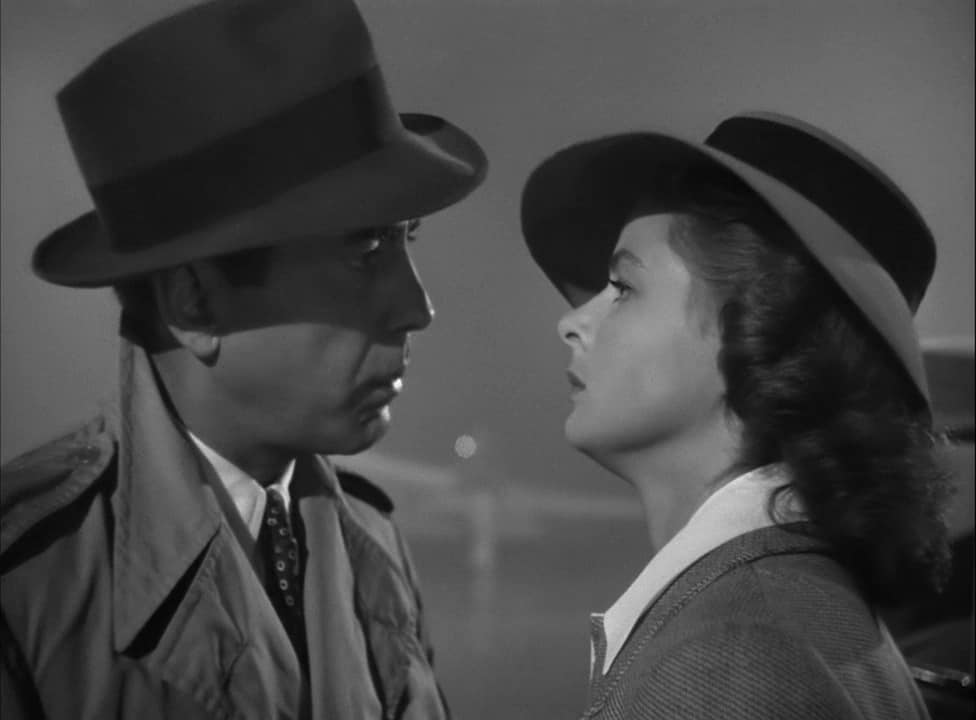
Casablanca: Screening Report

1)    Relate what was discussed in class or the text to the screening.


Along with Citizen Kane and the Godfather, Casablanca has over time been regarded as one of the best films of all time.  Although released around the same time as Citizen Kane, this film hit and emotional soft spot in audiences because it hit close to home.  Casablanca was released during a hard time in the world, World War II had broken out and everyone was on edge.  Stories from what was going on in Europe disgruntled everyone, and those who were living through it wanted an escape.  And their escape was America.  But to get to America they first had to get to Moroccan city of Casablanca, the final stop before refugees can finally get to America.  This movie takes place right in the middle of the war.  Which hit close to home.  During that time all you would hear on the news would be stories coming out of Europe and how life was over there.   The stories of war and escape are stories that we have read in books and this movie shows the struggles and challenges many faced while trying to escape a Nazi Europe to America.
            This movie was also released at a point where studios were using their power and influence in the movies theatres were playing.  Studios would make big blockbuster films that were guaranteed to make a lot of money but would also make B-list movies and force theatres to play them alongside the big budget movies.  It was a 2 for 1 special.  Casablanca was the one of the two.  Although not made for greatness, Casablanca would go on to be a classic movie in film history.  Upon its released although not critically acclaimed the film did receive a number of good reviews.  And eventually was nominated for 8 Academy Awards winning three including Best Picture.


2) Find a related article (on the film, director, studio, actor/actress, artistic content, etc.) and summarize the content.  You may use the library or the internet.
            Casablanca was another film that was shot in black and white but the lack of color just added to the sentiment and emotion of the movie. And although it was not as successful when it was first released, it has since then become a classic.  According to Jeffrey Sheban, author of “After 70 years, ‘Casablanca’ still thrills movie audiences” calls the film “one of the world’s most-watched films” and describes how even though the movie is over 70 years old it still attracts audiences.  (Sheban, 2012)
            In 2012, Casablanca returned to theaters for movie lovers to re-watch the beloved classic.  And many are still enamored by the movie as audiences were back in 1942.  Some comments made about the movie ““I am pretty nuts about it,” ““I usually watch it four times a year..,” and ““I can’t not watch it.”.  The article goes on to point the strong following Casablanca has had over the years. (Sheban, 2012)

Despite the “Hollywood” treatment Sheban points out that Casablanca was not portrayed accurately. (Sheban, 2012)  He described Casablanca in 1942 as the “jewel of the French colonial empire, famous for luscious art deco and neoclassic architecture” (Schemm 2012).  But it producers basically depicted what most Americans assumed the Middle East or more accurately Africa would look like.
The article then takes a look at the numerous now famous one-liners the movie has created stating “many memorable lines from the movie have worked their way into popular culture.” (Sheban 2012) Some one-liners include “Round up the usual suspects,” “We’ll always have Paris,” and “Here’s looking at you, kid,” "Louis, I think this is the beginning of a beautiful friendship." (Sheban, 2012). He even goes as far to clear up a misquotation that we have supported for over seventy years.
“Play it again, Sam” is a famous misquotation. Bergman’s character, Ilsa Lund, tells piano player Sam (Dooley Wilson): “Play it, Sam. PlayAs Time Goes By.”
                                                                                                (Sheban, 2012)

3) Apply the article to the film screened in class.   How did the article support or change the way you thought about the film, director, content, etc.?

            The article was very interesting did not change my opinion about the movie, but it does clarify for me the legacy of the film.  This article does show how in many ways the film has a strong following.  From the storyline that many can relate to, to a Hollywood version insight to the struggles of those in the middle of the war trying to escape and flee to America.
            In an unusual mix of elements combined do make Casablanca a classic.  With scenes that can be remembered clearly, lines that are still comment and said today, and reactions to the film as if it was released yesterday makes for a long lasting legacy movie.  This film not only told a story that although made for Hollywood did have some bits of history in it but it helped turned the real Casablanca city into a tourist attraction.  The movie has had such a lasting effect that people that have not watched the movie before know what it is and how big it is.  Casablanca has had such a cultural impact on society, it is a movie that no matter your age you see it and you can get a different reaction but still and admire for it.
            The article really touches on most of the cultural impacts the film has had on a new generation. Most of the original audience of Casablanca has probably already passed on so the new generations of audience still love the film.  The article also touches on the cultural impact in Casablanca and how even though in the film the city was portrayed differently it still helped the city.

4) Write a critical analysis of the film, including your personal opinion, formed as a result of the screening, class discussions, text material and the article. 
            Casablanca is a film that will be loved by audiences and critics alike for generations to come.  The strong following of the film just speaks volume about how a simple love story can touch so many heartstrings.  A film that for decades has been quoted and misquoted. It is a film that has impacted our culture very deeply.
            Although not every opinion on the movie is echoed everyone does react differently in my opinion that movie takes too long to get to the point and throughout the whole film I felt like I wanted more or the something more was about to happen but every time I was let down.  Besides my humble opinion, the film has a life of its own in the film industry.  It is a classic that people love to watch over and over again. It is one of those movies that some shows like to recreate scenes from.  A film that many have quoted including some quotes that I personally did not know came from the movie so that was refreshing to see.  Like many throughout history, Casablanca is a pop culture phenomenon but unlike the others it keeps on playing.  So play it, Sam!

CHECKLIST FOR PLAGIARISM 

1) ( x ) I have not handed in this assignment for any other class. 

2) ( x ) If I reused any information from other papers I have written for other classes, I clearly explain that in the paper. 

3) ( x ) If I used any passages word for word, I put quotations around those words, or used indentation and citation within the text. 

4) (  x) I have not padded the bibliography. I have used all sources cited in the bibliography in the text of the paper. 

5) ( x ) I have cited in the bibliography only the pages I personally read. 

6) (x  ) I have used direct quotations only in cases where it could not be stated in another way. I cited the source within the paper and in the bibliography. 

7) ( x ) I did not so over-use direct quotations that the paper lacks interpretation or originality. 

8) ( x ) I checked yes on steps 1-7 and therefore have been fully transparent about the research and ideas used in my paper. 


Name: ______________Juan Ortiz___________________  Date: ______3/30/14____________

Reference:
Sheban, Jeffrey. "After 70 years, 'Casablanca' still thrills movie audiences." The Columbus Dispatch. N.p., n.d. Web. 30 Mar. 2014.<http://www.dispatch.com/content/stories/life_and_entertainment/2012/03/20/on-that-you-canrely.html>.


Schemm, Paul . "'Casablanca' | Classic film's legacy still evident in port city." The  Columbus Dispatch. N.p., n.d. Web. 30 Mar. 2014.  <http://www.dispatch.com/content/stories/travel/2012/12/02/1-classic- films-legacy-still-evident-in-port-city.html>.

Thursday, March 20, 2014

Citizen Kane: Screening Report

1) Relate what was discussed in class or the text to the screening.
            Citizen Kane has been revered as the best film of all time, this according to the American Film Industry. In 1998 AFI constructed a list of the best films from the past 100 years.  Released in 1941 this movie was released during the peak of the “golden age of Hollywood” it had so much going for it, but it did not go as well at first.  All the critics praised the filmmaking and the movie itself but audiences did not take to the movie at first and was considered a commercial failure.             
William Randolph Hearst
            The film was basically blacklisted when it was first released. Many did not want to see it because the movie too closely resembled the life of William Randolph Hearst and felt that it was an attack on his character and persona.  Hearst owned many newspapers and he refused to publish and ads, stories or reviews about the film, he did not want to bring any attention to the film. Although critics loved the film, the audience was not drawn to the negative attention.  It wouldn’t be until much later that the film would be judged on basically what it is, a movie.
            In a historical perspective not only is this movie considered a great masterpiece it was also innovative.  His means of photography were innovative in the film.  Although the film was in black and white, one could still see the differences in lighting to put many people or stuff in the film into perspective.  The deep focus photography used in the film was also innovative.  With this style, it allows everything in the frame to in focus at once.

2) Find a related article (on the film, director, studio, actor/actress, artistic content, etc.) and summarize the content.  You may use the library or the internet.  
            This movie in my opinion is fascinating. From its release and the controversy surrounding it, to the actual film itself and the filmmaking and the beautiful artistry that went behind it.  When doing research on this film I had to find two articles that talk relatively about the controversy and the film as a whole.
            In an article by PBS regarding a show they did called “The Battle over Citizen Kane” they discussed the controversy surrounding the film.  In they article they describe the film as a "brutal portrait of newspaper magnate William Randolph Hearst” (PBS, 1997).  After Hearst found out about the film, he decided to go against it, and tried his best to shut the film down. And partly he succeeded.  Even Hollywood’s elites “rallied” with Hearst to try to get the negatives burned so the movie could never see the light of day. (PBS 1997) All of this because Hearst felt the film was made with the intent to discredit him (PBS 1997).  And Hearst got his way because the movie was a commercial failure and “it would be nearly a quarter-century before Citizen Kane was revived.” (PBS 1997) The movie was nominated for nine Academy Awards but during the ceremony, every time the movie’s name was called out the audience booed. (PBS 1997)
            But there was a reason why the film was nominated for nine awards, despite the content the filmmaking was outstanding.  Although in black and white, there was still so much life in the color.  According to Roger Ebert, Citizen Kane “makes great use of darkness and shadow” (Ebert, 1991).  The movie tells a sad story about a very rich, successful, influential person in American journalism and society and the black and white helps you feel even worse for Kane.  And the visual helped set the theme for the movie, Ebert says the Welles “created a gloomy, dark visual style for the picture” and it worked (Ebert, 1991).
While its initial release the movie was “black-booked” (Ebert, 1991), Hollywood studios would forbid their theaters show the film, so many people did not see it.  But now over 70 years later it is revered as a classic Hollywood and film masterpiece and as one of the best movies of all time.

3) Apply the article to the film screened in class.   How did the article support or change the way you thought about the film, director, content, etc.?
            While watching the movie, I understood the fascination with the filmmaking and the way he used the black and white to deepen and sadden the theme of the film but I was not the much interested in the film as I was to see what all the buzz was about.  Prior to watching the film, I had heard about it and how it was supposed to be the best film of all time so I was excited to watch it.  But was more interested in the controversy surrounding it.
            The article where they discussed all the trouble Hearst went, to get as little amount of people to watch is kind of comical.  And it intrigues me to see why he wanted to ban the film.  But it was Ebert’s review that helped me see the film in a new light after seeing it.  Welles had carefully planned every detail into this movie. Every person, car, clothes, place, thing, detail had a role in the movie.  From one word, “Rosebud” which is what the whole movie is about, to a snow globe, to the shadows and the light, they all had major roles not only in production but in the film as well.
4) Write a critical analysis of the film, including your personal opinion, formed as a result of the screening, class discussions, text material and the article.  I am less interested in whether you liked or disliked a film, (although that can be part of this) than I am in your understanding of its place in film history or the contributions of the director.
            Citizen Kane is one of those movies that no matter your personal opinion there is already a universal law about this movie.  So my opinion on the film does not matter, whether I liked it or not, this movie does belong in the list where it is now.  It is a captivating film that’s images and color drag you into the film.  Everything in the film was carefully calculated and placed exactly where they are.  It’s a mystery movie.  The mystery of a man’s life and last words, a sad movie about a rich, successful influential man who had everything but had nothing at the same time.
            The movie has and is surrounded by controversy ever since it first was released. It was a film that represented an alleged harsh view of newspaper tycoon William Randolph Hearst. And Hearst himself boycotted the film by not even mentioning, reviewing or writing about it.  He temporarily succeeding the film was only shown in a number of theaters


. But the critics loved the film because it was excellent filmmaking.  Each shot; each frame had an emotion behind it.  For me the black and white motif made the film even sadder, it makes you feel bad.  The rhythm of the film also made it sad and helps the content.  When he is young the movie is fast paced and fun while when he has aged the films moves slower and drags on a bit which make it all a bit sadder. 

            Citizen Kane is the movie of all movies.  It has everything you look for in a movie; mystery, humor, darkness and emotion. Citizen Kane is an amazing film, it’s captivating, interesting and there is controversy.  It’s juicy!


Reference:
PBS. "The Battle over Citizen Kane." PBS. PBS, n.d. Web. 20 Mar. 2014.             <http://www.pbs.org/wgbh/amex/kane2/index.html>.

Ebert, Roger. "'Citizen Kane' a masterpiece at 50." All Content. N.p., n.d. Web. 20 Mar. 2014. <http://www.rogerebert.com/rogers-journal/citizen-kane-a-masterpiece-at-            50>.

CHECKLIST FOR PLAGIARISM 

1) ( x ) I have not handed in this assignment for any other class. 

2) (  x) If I reused any information from other papers I have written for other classes, I clearly explain that in the paper. 

3) (  x) If I used any passages word for word, I put quotations around those words, or used indentation and citation within the text. 

4) ( x ) I have not padded the bibliography. I have used all sources cited in the bibliography in the text of the paper. 

5) (x  ) I have cited in the bibliography only the pages I personally read. 

6) ( x ) I have used direct quotations only in cases where it could not be stated in another way. I cited the source within the paper and in the bibliography. 

7) (xx  ) I did not so over-use direct quotations that the paper lacks interpretation or originality. 

8) ( x ) I checked yes on steps 1-7 and therefore have been fully transparent about the research and ideas used in my paper. 


Name: __________Juan Ortiz___________________  Date: _______3/20/14________